
Table of Contents
- Identify the Source of Pet Odors
- How to Clean Pet Accidents Naturally
- Using Baking Soda as a Natural Pet Odor Absorber
- White Vinegar and Apple Cider Vinegar for Odor Neutralization
- Natural Pet Odor Eliminator for Carpet and Rugs
- Best Natural Laundry Detergent for Pet Bedding
- Preventative Maintenance to Stop Pet Odors Before They Start
- Frequently Asked Questions
Last Updated: September 28, 2026
Identify the Source of Pet Odors
Before you can neutralize pet odors naturally, you need to identify their source. Understanding what you're dealing with makes your cleaning approach far more effective.
Pet accidents are the most obvious culprit. Urine contains uric acid crystals that sink deep into fibers and padding, making surface cleaning ineffective. Feces and vomit leave organic matter that breaks down and creates lingering smells.
Other sources include pet dander, wet fur, saliva on toys and bedding, and skin oils that accumulate on surfaces.
Note: the smell you notice may not be the main source. Air circulation, humidity, and poor ventilation can trap odors far from their origin.
Start your investigation here:
- Check under furniture where pets rest (odors concentrate underneath)
- Sniff near baseboards and corners (urine often pools in hard-to-see spots)
- Feel carpets and rugs for dampness (wet areas indicate urine saturation)
- Inspect pet bedding closely (this is usually the primary odor source)
- Look at upholstery seams where pets lie down
How to Clean Pet Accidents Naturally
Cleaning pet accidents quickly stops odors before they set in. The method must match both the surface and your pet type.
Understanding enzymatic vs. non-enzymatic approaches:
Non-enzymatic methods (vinegar and baking soda) work through chemistry and absorption. Vinegar neutralizes alkaline compounds like ammonia and uric acid, while baking soda absorbs moisture. These work well for fresh accidents but don't break down deep biological proteins in carpet padding or upholstery.
Enzymatic cleaners contain protease and amylase enzymes that digest organic matter in urine, feces, and vomit, making them effective on old, set-in accidents. For natural options, look for plant-derived enzymes without synthetic preservatives. A two-stage approach (vinegar first, then enzyme cleaner) often outperforms either method alone.
Pet-specific safety considerations:
Cats are sensitive to phenols (found in some essential oils and tea tree products), which are toxic to felines. Use diluted vinegar (1 part to 4 parts water) in cat areas. Baking soda is safe for both species but avoid applying near a pet's face.
Surface-specific cleaning process:
For carpet and synthetic rugs:
- Remove solid waste completely with paper towels
- Blot up liquid without rubbing (rubbing pushes urine deeper into padding)
- Mix equal parts white vinegar and water in a spray bottle
- Spray generously to saturate the spot and underlying padding (this is critical, surface-only treatment leaves deep odors)
- Let sit 10-15 minutes to allow acidity to break down uric acid crystals
- Blot thoroughly with clean cloth or towel
- Sprinkle baking soda over the entire affected area
- Leave for at least 4 hours (overnight is more effective for old accidents)
- Vacuum multiple times in different directions to remove all powder
- For stubborn accidents, repeat the entire process a second time
For hardwood and laminate floors:
- Blot immediately to prevent liquid from seeping into seams
- Use a more diluted solution: 1 part white vinegar to 3 parts water (full-strength vinegar can damage wood)
- Spray lightly, do not oversaturate
- Wipe dry immediately with a cloth to prevent water damage
- For lingering odors, place baking soda on the spot for 2-3 hours, then sweep (do not use vinegar a second time on wood)
- If the smell persists, the urine may have seeped under the floorboards; consider a natural enzyme cleaner designed for wood subfloors
For upholstery and fabric furniture:
- Blot fresh accidents immediately
- Test any cleaning solution on a hidden seam first to check for color bleeding
- Use a more diluted vinegar solution (1 part vinegar to 2 parts water) to avoid over-wetting fabric
- Spray lightly and blot; do not saturate upholstery as excess moisture promotes mold
- Sprinkle baking soda and let sit 2-3 hours
- Vacuum gently or brush away powder with a soft brush
- For delicate fabrics (silk, velvet), skip vinegar and use baking soda alone, or consult a professional cleaner
- For deep-set accidents in upholstery, a natural enzyme cleaner applied with a spray bottle and blotted immediately is often more effective than vinegar
Fresh accidents (within 24 hours) respond well to vinegar and baking soda. Older accidents require repeated applications or a natural enzyme cleaner. For best results, combine both: vinegar first to neutralize surface odors, then enzyme cleaner to digest embedded proteins. Plan for 2-3 treatment cycles over several days.
Using Baking Soda as a Natural Pet Odor Absorber
Baking soda is an effective natural odor absorber that traps odor molecules rather than masking them with fragrance.
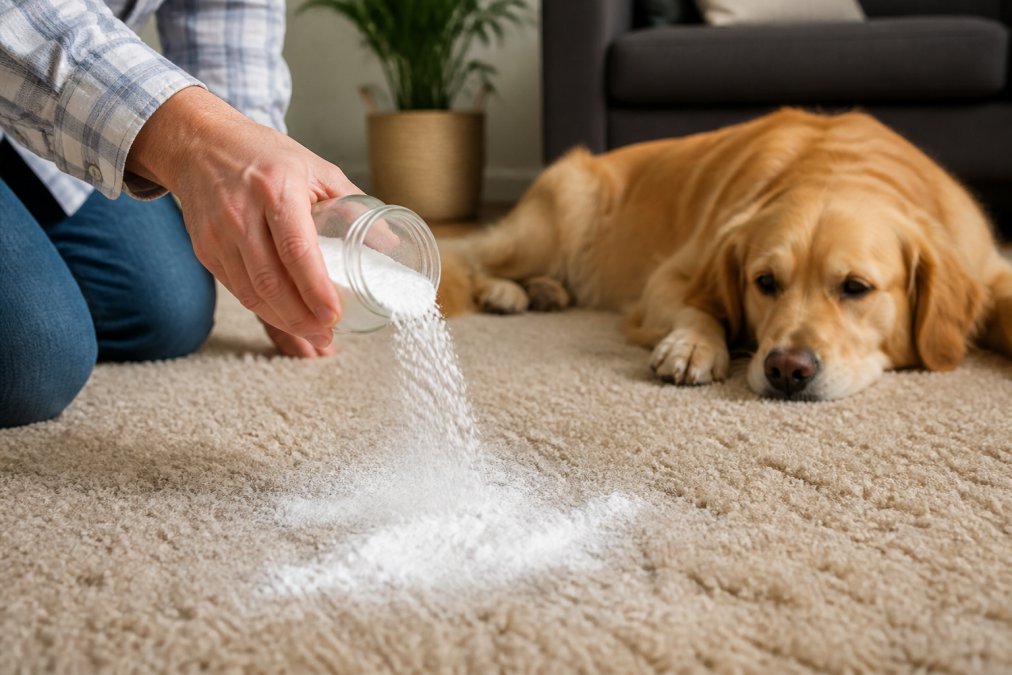
The powder's porous structure captures odor molecules until you vacuum. It's non-toxic and safer around pets than chemical deodorizers.
How to use baking soda effectively:
Highly Scented Luxury Carpet & Room →
- Sprinkle directly on affected carpet or rug
- Use enough to lightly cover the area (you should see white powder)
- Let it sit for at least 15 minutes (30 minutes or overnight for stronger odors)
- Vacuum thoroughly with multiple passes
- For upholstery, sprinkle, wait, then brush gently before vacuuming
Baking soda needs contact time to absorb odors. Vacuuming immediately wastes the product.
For ongoing odor control, sprinkle baking soda on pet bedding weekly. Let it sit for 15 minutes, then shake out the bedding outside or vacuum it. This prevents odors from building up in the first place.
Bain St Home's Carpet + Room Deodorizer combines baking soda with premium fragrance oils to both neutralize odors and leave a fresh scent. Just sprinkle, wait 10-15 minutes, and vacuum. It works on carpets, rugs, upholstery, and pet areas, anywhere pet odors linger.

White Vinegar and Apple Cider Vinegar for Odor Neutralization
Vinegar neutralizes pet odors through chemistry. White vinegar is most effective because its acidity breaks down alkaline compounds like ammonia and uric acid. Apple cider vinegar works similarly but has a stronger smell.
Using vinegar to neutralize pet odors:
- Mix equal parts white vinegar and water
- Spray generously on the affected area
- Let it sit for 10-15 minutes
- Blot with clean cloth
- Allow to air dry completely
The vinegar smell fades as it dries. For hardwood floors, use diluted solution (1 part vinegar to 3 parts water) and dry immediately. For pet bedding, add one cup of white vinegar to the wash cycle to neutralize embedded odors.
Natural Pet Odor Eliminator for Carpet and Rugs
Carpets and rugs trap pet odors because fibers and padding hold moisture and bacteria deep inside. Understanding the odor type determines whether vinegar and baking soda will work or whether you need enzymes.
Fresh urine odors respond to vinegar's acidity, but as urine sits for days, uric acid crystals bond with fibers and vinegar becomes ineffective. Enzymatic cleaners with protease enzymes digest the biological source at a molecular level. For natural options, look for plant-derived enzymes (protease, amylase, lipase) without synthetic preservatives or fragrances.
Use vinegar and baking soda for fresh accidents (within 24 hours) and preventative maintenance. Use natural enzyme cleaners for old accidents (more than 3 days old), persistent odors, and deep carpet saturation.
For established odors, use a three-stage approach: (1) Vacuum, spray vinegar solution, let sit 15 minutes, blot, and air dry; (2) Apply natural enzyme cleaner, let sit 4-12 hours, blot, and air dry; (3) Sprinkle baking soda overnight, vacuum thoroughly, and air the room.
Preventing re-odorization
Once you've deep-cleaned, prevent odors from returning by:
- Vacuuming pet areas at least twice weekly
- Washing pet bedding weekly
- Using baking soda preventatively on carpets every 7-10 days
- Addressing new accidents immediately (within hours, not days)
- Ensuring good air circulation in pet areas
Best Natural Laundry Detergent for Pet Bedding
Pet bedding is where odors concentrate most. Washing it regularly with the right detergent prevents odors from building up in the first place.
Washing pet bedding naturally:
- Shake out loose hair and dander before washing
- Use hot water if the fabric allows (heat helps remove odors)
- Add one cup of white vinegar to the rinse cycle
- Use a natural, plant-based laundry detergent
- Wash separately from human clothing
- Air dry when possible (sunlight naturally deodorizes)
Preventative Maintenance to Stop Pet Odors Before They Start
The best approach to pet odors is preventing them from developing. Regular maintenance stops odors before they become problems.
Frequently Asked Questions
What is the best homemade pet odor eliminator?
The most effective homemade pet odor eliminator combines baking soda with essential oils or white vinegar. Baking soda neutralizes odor molecules by absorbing them, while vinegar breaks down the compounds causing the smell. For carpets, sprinkle baking soda, let it sit 10-15 minutes, then vacuum. For upholstery, mix equal parts white vinegar and water in a spray bottle, apply lightly, and air dry. For pet bedding, wash with white vinegar added to the rinse cycle. These methods work best on fresh odors; enzymatic cleaners are necessary for deep-set urine smells.
How do I neutralize pet odors on upholstery and soft surfaces safely?
To neutralize odors on upholstery, first identify whether the smell is surface-level or absorbed into the fabric. For surface odors, sprinkle baking soda, let it sit 15 minutes, then vacuum thoroughly. For deeper smells, mix one part white vinegar with three parts water in a spray bottle, lightly mist the fabric, and allow it to air dry completely with good air circulation. Always test on a hidden area first. For pet bedding, wash in hot water with a natural laundry detergent designed for pet fabrics, adding white vinegar to the rinse cycle to neutralize remaining odors and break down biological residue.
Are essential oils safe for neutralizing pet odors around cats and dogs?
Most essential oils are toxic to pets, especially cats. Avoid applying essential oils directly to surfaces where pets rest or spend time. If using essential oils, ensure they're heavily diluted and applied only to areas pets cannot access, like upper shelves or closets. Instead, use pet-safe natural deodorizers: baking soda alone, white vinegar solutions, or enzymatic cleaners specifically formulated for pet odors. These options effectively neutralize smells without risking your pet's health. Always verify that any commercial deodorizer is labeled safe for use around pets when used as directed.
How often should I clean to prevent pet odors from building up?
Prevent pet odors by vacuuming high-traffic pet areas 2-3 times weekly to remove pet dander and hair before they decompose and create smells. Wash pet bedding weekly in hot water with natural detergent to eliminate biological stains and residue. Spot-treat accidents immediately with white vinegar or enzymatic cleaner to prevent urine smell from setting into porous surfaces. Air out carpets and upholstery regularly by opening windows to improve air circulation and reduce humidity, which traps odors. Deep clean carpets monthly with baking soda or a deodorizing spray to maintain freshness and prevent odor molecules from accumulating in synthetic fibers.
0 comments