
Table of Contents
- Why Diluting Concentrated Detergents Correctly Matters
- Your Cleaning Concentrate Dilution Ratio Chart
- How to Mix Cleaning Solutions Safely
- The Best Spray Bottles for Cleaning Concentrates
- How to Store Diluted Cleaning Products
- Common Dilution Mistakes and How to Avoid Them
- Water Quality, Disposal, and Other Factors That Affect Results
- Frequently Asked Questions
Last Updated: September 30, 2026
Why Diluting Concentrated Detergents Correctly Matters
The ratio decides whether you dilute concentrated detergents so they work or waste your money. This guide from Bain St Home covers exact measurements, safe mixing, and storage.
The Cost of Getting It Wrong
Over-diluting is the quiet budget killer: more product per job, faster bottle replacements, twice the scrubbing.
What Over-Diluting Does to Cleaning Power
Dilution ratio is the relationship between concentrate and water. Get it wrong on the weak side and you are mopping with scented water.
Your Cleaning Concentrate Dilution Ratio Chart
A dilution ratio tells you how many parts water to mix with one part concentrate. The chart below covers the most common household ratios.
Ratio |
Concentrate |
Water |
Best For |
|---|---|---|---|
1:10 |
1 part |
10 parts |
Heavy grease, degreasing |
1:16 |
1 part |
16 parts |
Multi-purpose spray |
1:32 |
1 part |
32 parts |
Light daily wipe-downs |
1:64 |
1 part |
64 parts |
Floor mop soap |
1:128 |
1 part |
128 parts |
Light floor maintenance |
Reading the Numbers: 1:10, 1:64, and Beyond
The first number is always the concentrate: when you dilute concentrated detergents, 1:10 means one part cleaner to ten parts water.

Calculating Parts Per Million for Disinfecting
Parts per million (PPM) measures how much active ingredient ends up in your final mix. Disinfecting products list a target PPM on the label.
How to Mix Cleaning Solutions Safely
Safe mixing comes down to three things: the right container, measurements, and protection. Skip one and you waste product or create a hazard.
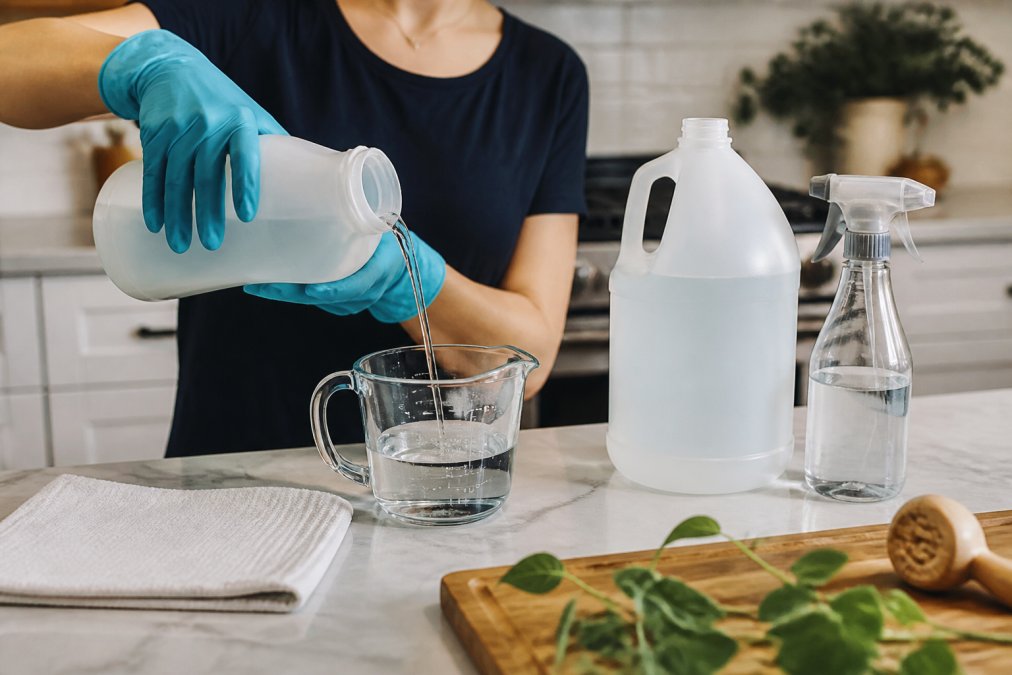
Step-by-Step Mixing Instructions
- Read the label ratio and write it down.
- Put on gloves and eye protection.
- Measure water into your mixing vessel first.
- Add the concentrate second.
- Stir gently, do not shake, to avoid foaming.
- Label the bottle with the date and ratio.
- Wipe the rim and cap it tightly.
Adding concentrate to water, not water to concentrate, keeps splashing down and mixes more evenly.
PPE and Safety Data Sheet Basics
Never mix bleach-based products with ammonia or acid cleaners. The fumes can be dangerous. Check labels before combining anything.
The Best Spray Bottles for Cleaning Concentrates
The right bottle makes accurate dilution almost automatic. The wrong one leaks, clogs, or dribbles concentrate down your hand.
Metering Tips and Dispensing Systems
A metering tip is a small insert that controls how much concentrate flows per ounce of water. Swap the tip and you change the ratio.
Bottle Type |
Best For |
Watch Out For |
|---|---|---|
Marked spray bottle |
Daily sprays |
Fading printed lines |
Trigger sprayer |
Multi-purpose mixes |
Clogging with thick soaps |
Pump sprayer |
Large floor jobs |
Over-pressurizing |
Foam cannon |
Thick foaming mixes |
Needing exact ratios |
How to Store Diluted Cleaning Products
Mixed solutions do not last forever, the clock starts the moment water hits concentrate. Store them cool, dark, and labeled, and know when to pour a batch out.
Shelf Life and Chemical Stability
Chemical stability drops once you add water. Most diluted mixes are best used within a few weeks, but the window varies:
- Quaternary ammonium disinfectants: typically 7 to 30 days once diluted, depending on the manufacturer. Follow the label's "use within" window, the PPM you mixed on day one is not the PPM on day forty.
- Hydrogen peroxide cleaners: break down fastest. Light and warmth accelerate the reaction, so an amber or opaque bottle in a cabinet holds potency far longer than a clear bottle on a sunny counter.
- Bleach-based mixes: lose strength quickly. Mix fresh daily for disinfecting tasks, because active chlorine dissipates even in a sealed bottle.
- Surfactant-only cleaners (mop soaps, multi-purpose sprays): the most stable category. They may keep working for a month or more, but fragrance fades and some preservatives lose ground.
The Bacterial Growth Problem Nobody Mentions
Here is the part most guides skip: a diluted detergent is mostly water, and water is a growth medium. Diluting weakens or removes the preservative system that kept the concentrate shelf-stable, so a spray bottle in a warm garage can become a biofilm habitat.
The practical signs a batch has gone off:
Multi-Purpose Cleaner Concentrate 16oz →
- A sour, musty, or "wet dog" smell that was not there when you mixed it.
- Cloudiness, sediment, or a film inside the bottle.
- A color change from the day you mixed it.
- Reduced foaming or a slick feel that does not match the original mix.
Storage Conditions That Actually Extend Shelf Life
- Temperature: keep diluted mixes between roughly 50°F and 77°F. A hot garage or summer windowsill can cut usable life in half.
- Light: store in opaque bottles or a closed cabinet. UV degrades peroxide and chlorine actives quickly.
- Headspace: fill bottles close to the top. Air means oxygen exposure and more room for contamination.
- Seal: cap tightly. A loose cap lets water evaporate, quietly concentrating your mix and throwing off the ratio you worked to get right.
- Clean containers only: never pour a fresh batch into a bottle that held an old one without washing it first. Residue seeds the new batch.
Mix small batches often instead of one big jug you will never finish. Fresh solution cleans better, smells the way it should, and will not turn into a science experiment in your utility closet.
Labeling Compliance and Reusable Containers
Labeling compliance matters even at home: if a bottle is unmarked, nobody knows what is inside, and if a child or guest picks it up, the consequences are on you.
Write four things on every reusable container:
- What it is (product name, not just "cleaner")
- The dilution ratio you used
- The date you mixed it
- A discard-by date based on the shortest shelf life in the mix
Common Dilution Mistakes and How to Avoid Them
Most dilution problems trace back to the same handful of habits. Fix these and results improve fast.
- Eyeballing the pour. Use a measuring cup every time.
- Adding concentrate first. Always start with water.
- Reusing a dirty bottle. Old residue throws off the ratio.
- Skipping the label. You will forget what is inside within a week.
- Mixing bleach with other cleaners. Dangerous fumes, no upside.
- Shaking to mix. Creates foam and wastes product.
Water Quality, Disposal, and Other Factors That Affect Results
Two variables wreck more dilution batches than bad math: the water you pour in, and what you do with a batch that has gone wrong.
How Hard Water Changes Your Dilution Math
Hard water carries dissolved calcium and magnesium, which do two things to a diluted detergent:
- They bind to surfactants. The molecules that should be lifting grease latch onto minerals instead, so you need more concentrate for the same cleaning power. A 1:64 mop soap that works on soft water can feel weak on hard water at the same ratio.
- They leave scale and spots. On glass, stainless, and dark sealed floors, minerals stay behind after the water evaporates. That is the film you blame on the cleaner.
- Bump the concentration slightly for cleaning tasks, not for disinfecting. Never exceed a disinfectant's labeled ratio to compensate for water quality; use a manufacturer-approved alternative instead.
- Switch to distilled or filtered water for glass cleaners, streak-prone surfaces, and any spray you use on stainless. Distilled water costs a few dollars a gallon and eliminates the mineral variable entirely.
Soft Water and the Opposite Problem
Soft water is not automatically better. With fewer minerals competing with the surfactant, the same ratio can feel stronger, a 1:64 floor mix may behave like a 1:32. Start at the labeled ratio and adjust down only if you see residue or streaking.
Disposing of Expired or Mis-Mixed Batches
When a batch goes bad, wrong ratio, wrong chemistry, or just too old, do not pour it down the drain without thinking. Chemical waste should follow local disposal rules, and many areas run household hazardous waste drop-off days.
A practical decision tree:
- Surfactant-only mixes (mop soaps, general sprays) that are simply old: usually safe to flush down a utility sink with plenty of running water, unless your local rules say otherwise. Check first.
- Disinfectants, bleach mixes, and anything with an active pesticide or antimicrobial: take these to a household hazardous waste facility. Do not pour them into a storm drain, a yard, or a septic system.
- Accidentally mixed bleach with ammonia or acid cleaner: do not pour it out. Ventilate the area, leave the container sealed and outdoors away from people and pets, and contact your local hazardous waste authority or poison control.
- Unknown contents in an unlabeled bottle: treat it as hazardous. You cannot safely guess what is in it.
Verifying What You Actually Mixed
Two low-cost tools close the loop:
- Test strips for pH or specific actives (quaternary ammonium strips are widely available) tell you whether a disinfecting batch is still in range. Dip, compare, done.
- A refractometer measures dissolved solids, overkill for a single spray bottle, but handy if you mix the same product by the gallon and want a fast read on whether a batch matches your target.
If a batch tests out of range, do not add more concentrate. Dump it and start over, the math is faster than the guesswork.
Frequently Asked Questions
What is the standard dilution ratio for cleaning concentrates?
Standard ratios vary by product and task. Our Multi-Purpose Cleaner Concentrate uses a 1:7 ratio (16 oz concentrate to 112 oz water), while our Luxury Designer Fragranced Mop Soap Concentrate calls for 1:32 (4 oz per gallon). Always check the product label, because the manufacturer formulates for a specific active-ingredient level. Using the wrong ratio can leave residue or fail to clean. When in doubt, start with the label's recommendation and adjust only if you see streaking or dullness.
Can you mix different cleaning concentrates together?
No, mixing different concentrates is risky. Combining a bleach-based cleaner with an acid-based product can release toxic chlorine gas. Even plant-based formulas may contain surfactants or pH adjusters that react poorly together. If you need two actions, clean with one product, rinse, then use the second. For convenience, stick to one concentrate per bucket or spray bottle unless the label explicitly says it is safe to combine with others.
How long does diluted cleaning solution last?
Most diluted solutions last 1 to 4 weeks if stored in a sealed container away from heat and sunlight. Water quality matters: minerals and bacteria in tap water can shorten shelf life. If the solution becomes cloudy, smells off, or shows mold, discard it. For best results, mix only what you need for a week or two. Label the bottle with the mix date so you know when to replace it.
What safety precautions should be taken when diluting chemicals?
Wear gloves and eye protection, especially with concentrates that carry a hazard warning. Work in a ventilated area, and never use food containers for mixing. Read the safety data sheet for first-aid and handling instructions. If you splash concentrate on your skin, rinse with plenty of water. Keep pets and children away from the mixing area. Store all diluted products in clearly labeled bottles, and keep the original concentrate locked away from curious hands and paws.
0 comments