
Table of Contents
- Why Your Standard Air Freshener Is a Hidden Risk for Pets
- What Makes a Non Toxic Home Fragrance for Pets
- Pet Safe Essential Oils for Home Use (and the Ones to Skip)
- How to Remove Pet Odors from House Naturally
- Choosing the Right Format: Sprays, Diffusers, and Candles
- Signs of Respiratory Distress in Pets and When to Act
- Frequently Asked Questions
Last Updated: September 24, 2026
Why Your Standard Air Freshener Is a Hidden Risk for Pets
That plug-in air freshener in your hallway might be irritating your pet's lungs with every burst of synthetic fragrance. The American Society for the Prevention of Cruelty to Animals (ASPCA) warns that many common air fresheners contain volatile organic compounds (VOCs) and other chemicals that can cause respiratory issues in pets, especially birds and small mammals.
What Makes a Non Toxic Home Fragrance for Pets
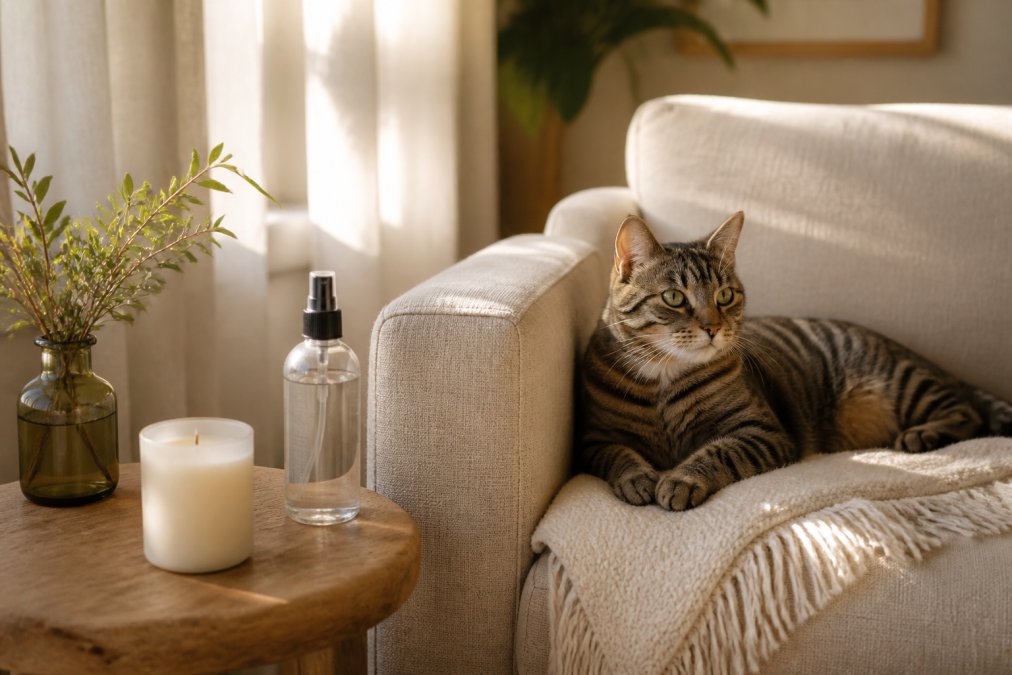
A non toxic home fragrance for pets is formulated without synthetic fragrance, phthalates, parabens, or other known irritants, using plant-derived ingredients and clean-burning waxes instead.
Ingredients to Avoid: Phthalates, Parabens, and Synthetic Fragrance
Phthalates make fragrances last longer and are linked to hormone disruption in humans and animals. Parabens act as preservatives and can trigger allergic reactions in sensitive pets. Synthetic fragrance is the biggest red flag: a proprietary blend that doesn't require full disclosure.
Species-Specific Toxicity: Cats vs. Dogs
Cats and dogs process chemicals differently. Cats have a limited ability to metabolize certain compounds because their livers lack specific enzymes, making them far more vulnerable to essential oil toxicity than dogs. A diffuser blend that's fine for your golden retriever could send your cat into respiratory distress.
Pet Safe Essential Oils for Home Use (and the Ones to Skip)
Essential oils are the most misunderstood category in pet-safe home fragrance. The same oil can be harmless by one exposure route and dangerous by another, fine for a dog and toxic to a cat. Before you diffuse anything, understand three variables: the oil, the species, and the route of exposure.
Why Cats and Dogs Are Not the Same
Cats are the outlier. Their livers are unusually low in glucuronyl transferases, the enzymes most mammals use to break down plant compounds, drugs, and chemicals. When a cat inhales or ingests a compound it cannot metabolize, it accumulates instead of being excreted, which is why a diffuser blend that barely affects a Labrador can cause drooling, wobbliness, or respiratory distress in a cat.
Exposure Route Matters More Than the Oil
Most pet owners focus on which oil to use and ignore how it reaches the animal. Risk changes dramatically by route:
- Inhalation, the lowest-concentration route, but the most common. A diffuser running in a closed room concentrates airborne oil droplets over time.
- Topical, oils applied to a pet's skin or fur, or transferred from your hands after you handle a bottle. Cats groom this off and swallow it.
- Ingestion, the highest-risk route. This includes a pet licking a spill, drinking from a diffuser reservoir, or grooming a surface where oils have settled.
Oils Commonly Cited as Lower Risk (With Caveats)
When heavily diluted and used in a well-ventilated space with an escape route, the oils most often cited as lower concern for dogs are lavender, chamomile, frankincense, and ginger.
Oils to Avoid Entirely Around Pets
These oils appear repeatedly on veterinary toxicity lists and should not be diffused, sprayed, or applied in a home with pets:
- Tea tree (melaleuca)
- Eucalyptus
- Peppermint and other high-menthol mints
- Citrus oils (d-limonene is the primary concern)
- Pine and other conifer oils
- Wintergreen (contains methyl salicylate)
- Cinnamon and cassia
- Clove
- Ylang-ylang
- Anise
Practical Rules for Diffusing Around Pets
If you decide to diffuse, treat it as a controlled exposure rather than background ambience:
- Diffuse in a room your pet can leave. Never close a cat or dog in with a running diffuser.
- Keep sessions short. Run the diffuser for 15-30 minutes, then ventilate. Continuous all-day diffusion is where most problems start.
- Use the smallest amount that produces a scent. More drops means a higher airborne concentration, not a better result.
- Never diffuse in a room with a bird, reptile, or small mammal.
- Stop immediately if you see squinting, head-shaking, drooling, or pawing at the face. Those are early signs of irritation, not personality quirks.
How to Remove Pet Odors from House Naturally
Most air fresheners fail at pet odor for a simple chemical reason: they don't remove the odor molecule, they bury it under a stronger one. That's masking, the odor is still there, still binding to surfaces, still detectable the moment the fragrance fades. Real odor removal means changing the molecule itself.
Masking vs. Neutralizing: The Actual Difference
Pet odors come from volatile organic compounds, the same broad category that includes fragrance ingredients. Urine, feces, saliva, and anal gland secretions release sulfur- and nitrogen-containing compounds (mercaptans, amines, ammonia) that your nose reads as "pet smell."
- Break them apart chemically. Enzyme cleaners use bacterial enzymes and surfactants to cleave the odor molecule into smaller, non-odorous pieces. This is why enzyme cleaners work on urine that has soaked into carpet or grout, and why a standard detergent does not.
- Bind them to a solid. Activated charcoal and zeolites are porous materials with enormous internal surface area. Odor molecules stick to the surface and are held there instead of floating into your air. Baking soda works on a smaller scale by adsorbing acidic odor compounds.
- Oxidize them. Hydrogen peroxide and certain oxygen-based cleaners chemically alter odor molecules. This is effective but must be used carefully around pets and fabrics, since peroxide can bleach color.
A Step-by-Step Neutralizing Routine
Step 1, Find the source, not the smell. Odor travels, so the spot you smell is often not the dirty spot. Use a blacklight on carpet and upholstery to locate dried urine, and check baseboards, the underside of furniture, and around the litter box.
DIY Pet-Safe Odor Neutralizer Recipes
These are simple, low-cost, and use ingredients you likely already have. None replace enzyme cleaning on a fresh accident, they're for lingering background odor.
Baking soda dry sprinkle (carpet and rugs)
- Sprinkle a thin, even layer of plain baking soda over dry carpet.
- Let it sit 15-30 minutes.
- Vacuum thoroughly. Repeat weekly in high-traffic pet areas.
Vinegar and water surface spray (hard floors, litter box exteriors)
- Mix one part white vinegar to one part water in a spray bottle.
- Mist surfaces and wipe with a clean cloth.
- Do not use on marble, stone, or aluminum, acid etches those surfaces. Rinse thoroughly, since some pets dislike the vinegar scent and residue.
Simmer pot (whole-room background scent)
- Simmer a pot of water with a few sprigs of fresh parsley, a handful of mint leaves, or a sliced apple.
- Let it simmer 20-30 minutes, then turn it off and remove the pot before your pet re-enters the room.
- Never leave a simmering pot unattended, and never add essential oils to it if a cat or bird is in the home.
Litter Box Odor and Ammonia at the Source
Litter box odor is mostly ammonia, produced as bacteria break down urea in urine. Ammonia is a respiratory irritant for cats and humans alike, and a leading reason cats stop using the box. Scoop at least once daily, twice in a multi-cat home. Replace litter weekly, and wash the box with unscented soap and water rather than a scented cleaner.
Choosing the Right Format: Sprays, Diffusers, and Candles
Not all fragrance formats are equal when pets are in the house. Here's how the main options compare:
| Format | Pros | Cons | Best For |
|---|---|---|---|
| Room sprays | Immediate effect, easy to control | Fades quickly, can startle pets | Quick refresh before guests |
| Reed diffusers | Continuous, no electricity | Constant exposure, hard to control | Well-ventilated, pet-free rooms |
| Ultrasonic diffusers | Adjustable intensity | Essential oil risk, humidifies air | Homes without cats or birds |
| Candles | Ambiance, warm scent | Open flame, soot risk | Supervised use only |
| Wax melts | No flame, strong scent | Synthetic wax common | Pet-free zones |
Candle Safety for Pet Owners
Candles add warmth and atmosphere, but open flames and pets don't mix. Curious cats knock them over; dogs wag tails into low tables. Even a well-behaved pet can accidentally start a fire.
Signs of Respiratory Distress in Pets and When to Act
Knowing the warning signs can save your pet's life. Respiratory distress doesn't always look dramatic. It can start subtly and escalate quickly.
Watch for:
- Excessive coughing or wheezing
- Open-mouth breathing in cats
- Labored breathing or visible effort
- Blue tint to gums or tongue
- Lethargy or reluctance to move
- Pawing at the face or nose
Frequently Asked Questions
How can I make my house smell good without harming my pets?
Choose fragrance products labeled non-toxic and free from phthalates, parabens, and synthetic fragrance. Look for plant-derived ingredients and VOC-free formulas. Simmering a pot of water with pet-safe herbs like rosemary or mint, or using a hypochlorous acid-based odor neutralizer, are safe alternatives. Always ventilate rooms and keep products out of reach of pets. If you use essential oils, verify each oil is safe for your specific pet species before diffusing.
Which essential oils are toxic to cats and dogs?
Tea tree, eucalyptus, peppermint, citrus, pine, and wintergreen oils are toxic to both cats and dogs. Cats are especially sensitive because their livers lack the enzyme needed to metabolize many compounds found in essential oils. Even diffusing these oils can cause respiratory irritation. Safe options for most pets include lavender and chamomile in low concentrations, but always consult your veterinarian before introducing any essential oil into a home with pets.
Is it safe to use reed diffusers around pets?
Reed diffusers release fragrance continuously, which can overwhelm a pet's respiratory system in enclosed spaces. If you use one, place it in a well-ventilated area your pet cannot reach, and choose a diffuser made with pet-safe essential oils or plant-derived fragrance. Watch for signs of respiratory sensitivity such as coughing, sneezing, or lethargy. When in doubt, swap the diffuser for a room spray you can apply briefly and ventilate afterward.
Are soy candles safer for pets than paraffin candles?
Soy candles are generally a better choice because they burn cleaner and produce less soot than paraffin. Coconut soy wax blends are especially popular for a clean-burning experience. However, the fragrance oils used matter just as much as the wax. Choose candles scented with non-toxic, phthalate-free fragrance and always trim the wick to reduce smoke. Never leave a burning candle unattended around pets, and keep them on a high, stable surface.
Your pet's health shouldn't be a guessing game. The next time you reach for a room spray or candle, check the label. If you can't pronounce it, your pet probably shouldn't breathe it. At Bain St Home, we craft small-batch, clean-label home fragrances made in Missouri with cruelty-free ingredients. Our room sprays and coconut soy candles are designed for homes where pets are family. Get your Fall Bundle and create a home that smells amazing without the hidden risks.
0 comments